Biography
Jane Neal – art curator, art consultant, art writer
Bogdan Mihai Radu (b. 1979, Sibiu, Romania. Lives and works in London).
Is a Romanian-born, London-based painter. Primarily figurative, Radu is known for his dramatic, light-filled landscapes, seascapes, floral still lifes and vivid, abstract paintings. While he grew up under the last years of communism, Radu had an idyllic childhood in many ways. He spent it playing in the iris-filled fields of Transylvania that surrounded the town of Talmacui, where he grew up. Talmaciu was where Radu discovered his fascination for art. As a boy he would visit his mother in the string factory where she worked in the cross-stitch section. Radu was mesmerised by the array of threads that were soaking in brilliantly coloured dyes. He was also fascinated by the cross-stitch kits themselves.
The images that had been printed for people to stitch were Radu’s first introduction to art. It is interesting how different experiences at key moments in a child’s life can resonate later. The young Radu was very taken with the stories he heard about the owner of the factory, who was English.
Perhaps Radu was more intrigued than most because his grandparents lived in a villa built by the factory owner. It piqued the young boy’s interest in England and the English, so much so that eventually he found himself living in London as an adult. Several of the subjects depicted on the cross-stitch kits were by well. known English painters – John Constable being one of the reproduced artists. Constable has been a source of inspiration to Radu throughout his career, notably his treatment of the sky, light and his pioneering use of colour in landscape painting at a time when it was de rigueur to coat works with thick, brown varnish to ‘finish’ them.
Radus experience of the factory coincided with another formative event. He saw a film about an art robbery. Priceless, iconic paintings were stolen from museums and private collections and replaced by near-perfect replicas in order to ensure the owners would never even realise that the theft and swap had taken place. The intricate plot behind this film not only caught Radu’s attention, it also inspired him to follow suit. He ‘borrowed’ the paintings of his grandparents and other relatives – claiming that he needed them for school – and set to work on the business of reproducing them. He then presented these beautifully executed reproductions to their owners. As in the film, Radu’s family never suspected anything.
Although Radu had expressed a clear interest in art from an early age, his parents felt it best to enrol him in a local high school that focused on the study and workings of the railway in order to ensure him a future career. Radu had other ideas. He refused to abandon his artistic studies and, as he became older, he decided to attend Friedrich Müller’s college classes and became a certified art therapist.
Shortly after, he began volunteering in centres for disabled children. By witnessing the benefits to the children that art therapy gave them – their joy at making their own work and their willingness to participate in artistic activities, not to mention the miraculous effects of colour on their psychology – Radu was inspired. He determined to pursue an artistic career.
In 2007, Radu was admitted to the Art and Design University of Cluj. At the same time, he attended master classes there with Cornel Brudascu – a respected painter from the older generation whose work has greatly influenced Radus practice. Following his studies, Radu continued to exhibit in Romania. He had an eponymous solo presentation at the Students’ Culture House in Cluj and a show entitled ‘It’s tiring to be a painter’ at the Green Hours Jazz Cafe in Bucharest.
Ten years later, Radu felt he needed to make some changes in his practice. His focus shifted, moving from floral still lifes and landscapes to seascapes and more abstract works. After participating in the Oxford International Art Fair in 2018 (where he won first prize, which resulted in him being invited to present his work as a special guest at the Tokyo International Art Fair), Radu moved to London to draw inspiration from a different culture and environment. Even before he began absorbing London life, it is apparent from the reaction to Radus work that people could sense his anticipation and excitement about moving to a new city and country.
Richard Knight from Christie’s, Oxford, commented on Radus paintings at the Oxford International Art Fair: ‘A Romanian artist whose works spoke volumes at the entrance to the show. On an immense scale that’s immersive, Bogdan’s abstracted expressionism is bold and striking, dense with mood and emotion!
Radu exhibited twice at the Romanian Cultural Institute after arriving in London: Tony Blair visited his 2019 show ‘Searching for Life’, and after the second exhibition there in 2021, ‘Eight Regained Moments’, the artist was included in Paul Kenyon’s book Children of the Night (2022). In 2021, Radu had a solo exhibition entitled ‘Queen Marie’s Heart, at Mogosoaia Palace, near Bucharest, and his painting Yellow Flowers
2021) was shortlisted for the Royal Academy of Arts
Summer Exhibition.
In November 2020, Radu received an order of merit from Romania, or more precisely, The Order of Cultural Merit in the rank of Knight, Category C, Fine Arts’, for his contribution to arts and culture.
This was in recognition of his own talent, but also an acknowledgment of his part in promoting a positive image of Romania in the United Kingdom.
Radu’s works are included in several important museum collections – one of the most prominent being the Cotroceni National Museum in Bucharest, Romania, and in notable private collections, including the Romanian Royal Family.
Radu continues to live and work in London and has recently taken British citizenship.
Dr. Michael J. Prokopow
cultural historian and curator
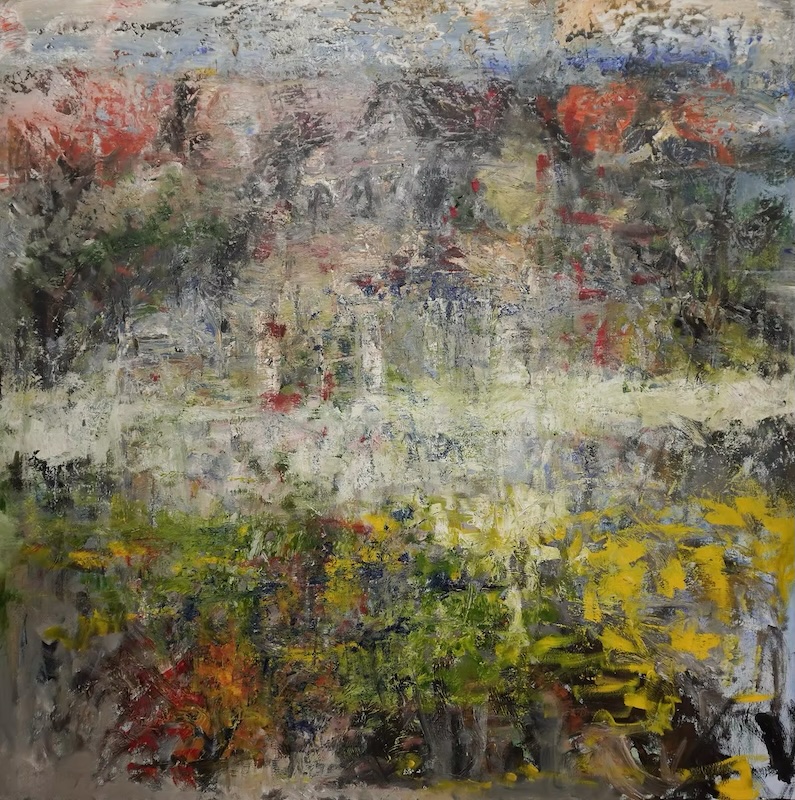
In writing about the condition of contemporary art (meaning the art that ‘presents the present’) the critic Boris Groys argues that three dominating temporal, ideological and social conditions define and explain 20th-century cultural production: that of modernity which was ‘directed towards the future’; that of postmodernity which critiqued the modernist project and that of the contemporary (or what has been termed “contemporaneity”) which, as the author explains, ‘privileges the present with respect to the future and the past’.
Groys’s efficient summary of the operations of the art of the ever-fleeting present and its relationship to multiple pasts offers a useful framework for considering the practice of Romanian–British painter Bogdan Mihai Radu. Radu is an artist who, in favouring impasto, makes thematically and physically complex works which, in drawing upon such varied visual and material histories as 19th-century British romanticism and mid-20th-century Atlantic American abstraction (as well as revealing an awareness of other post-war European developments) has fashioned an original, distinct and often personal painterly language that considers place, memory and experience.
Born in 1979 in Sibiu, Romania, Radu discovered early on the pleasures of art, the particular pleasure afforded by the material operations of painting and how, in terms of his own existence, the work of looking at the world, thinking and translating experiences and ideas into images would be his life’s work. Having come of age in the decade after the violently liberating December Revolution of 1989 and the optimism of a post-communist future, Radu – like many other artists of his generation working both in the country and out of it – understood, nonetheless, that art was rooted in the aesthetic preferences and visual practices of a national culture still suffering from the constraints of communism and consequences of the severing of a long and distinguished history of critical and artistic exchange with the West. For Radu, however, the desire – the need – to expand his understanding of art and to experiment with new ways of image-making was realised in 2018 by his decision to leave Romania and move to London. This self-aware, affirming act was transformative and made it possible for Radu to continue refining the distinct material language of his emotionally powerful work.
In occupying the entwined space of documentation and critique, where ideas, feelings and observations are translated into images that rewardingly blur (or wisely leave ambiguous) the lines between representation and abstraction, Radu’s layered, dense paintings require scrutiny. His is a practice that exemplifies the relationships between the appearance of things and the mysteries of what lies beneath the surface of an image and the myriad forces that have resulted in its making. Radu’s paintings – whether bright and open or dark and restive – capture and convey the affective and psychological complexities of the contemporary age as the product of layered and simultaneously present pasts, shared and known, private and guarded, fierce and vulnerable. The Romanian word regăsire means ‘recovery’ when translated into English. The several implications of the term – recall, reclamation and well-being among them – are fitting when looking at and thinking about Radu’s visually satisfying, resonant works. Whether of places or psychic states (whether observed or imagined), his paintings exist as compelling vehicles for careful, deliberative contemplation because of the knowledge – the understanding – of assured returns.
Light of Life: The Paintings of Bogdan Mihai Radu
Jane Neal – art curator, art consultant, art writer
The play of light that was constantly changing around him left its mark on Radu. An admirer of Constable’s studies and paintings of nature, he – like the great artist before him – has also born witness to how the sky ‘governs everything’. Though Radu’s practice can be divided according to different genres – landscapes, seascapes, floral still lifes, abstract works and, more recently, scenes of London life – whatever the artist’s chosen focus, we are always aware of the shifting play of light and how it affects his subject matter.
Radu’s feeling for how the light changes the appearance of the sky and then everything beneath it is especially evident in his landscapes and seascapes. Transylvania in Spring (2020) depicts an idyllic pastoral landscape. Irises and wild flowers tumble together in the foreground, their heads and faces coming forwards or receding according to the play of hazy light that diffuses across the softly undulating landscape, glancing over the village in the mid ground and fading to softness in the background so that the horizon line remains deliberately indistinct, a soft blanket of cloud hovering over and slightly obscuring the fields beyond.
Everything Wet (2021) is another example of everything starting with the sky. In this case, the spiral of rain clouds that appear to have drawn everything into their path. The ground looks sodden, weighed down by the deluge. There is something very tactile and inviting about Radu’s painting. His work is very textural. The paint glides onto his canvases in thick, glistening strokes and he pushes it around, creating layers and then scraping back and working again into the new skin of the surface. This multi-layered approach is very engaging as it lends a certain animation to Radu’s work, a liveliness that suggests the works are in flux, even in conversation with, the elements and landscapes that the artist captures.
This liveliness is perhaps even more apparent in Radu’s seascapes. The artist was always fascinated by marine landscapes but it took him some time before he had the courage to tackle the subject for himself. In 2018, the artist painted Restless Sea. Instead of taking a tentative approach and starting small, Radu chose to go big and worked on a canvas of 1.5 metres in height and 3 metres in width. The decision to work on a ground that was wider than it was tall makes perfect sense given the nature of the subject. It is difficult to ascertain or create depth with marine landscapes because of the strongly present horizon line that divides sky from sea, so we look to the sky and to the waves to find markers to focus on. Here though, Radu has created a thick bank of cloud that serves as a very effective counter-balance to the animated waves crashing against the rocks below. It is a powerful painting – one that required bravery to make, as well as skill. The work also marks a turning point in Radu’s artistic journey.
The artist says he chose a large scale for this painting because he wanted to mark the decision to differentiate his new work from his previous practice, and also to express the ideas and emotions that he felt had been building up until this point. Given the title of the work, it is of course also possible to suggest that, in a way, the painting is a self-portrait – or at last indicative of the artist’s restless state of mind as this work and this time marked a number of significant changes in the artist’s life. If we look at Material Nature, which was painted in 2020, we see how Radu was already beginning to move his practice in a more abstract direction. In some areas, it is as if he has scratched into the painting’s surface – with sgraffito-like technique. Bright-blue lines criss-cross the foreground from right to left and back again, and, in the mid ground, moving up to the top right-hand corner, we see how the artist has scraped the paint in a horizontal direction, as if with a card or squeegee.
It is very clear when studying this painting that Radu had started looking beyond the frame of reference he had previously been influenced by when creating his works. In this case we can look to artists such as Gerhard Richter – most notably his 1994 painting Abstract Painting (809-3), now in the Tate Collection, the first of a series of four paintings. Up to this point, Radu had been inspired by and a follower of the Cluj-based artist, Cornel Brudașcu. The older artist was an important figure for several painters who have emerged from Cluj, most notably Victor Man. Brudașcu returned to certain themes again and again, such as floral still lifes, the landscape and the male nude. While not an ‘official’ teacher at the academy, students considered it a great honour to be invited to the artist’s studio to see him at work and to receive what can best be described as a ‘master class’ in painting. He clearly inspired the young Radu – particularly in his lively, painterly style and choice of subject matter. Perhaps the best and most important gift Brudașcu bequeathed, though, was to encourage his ‘students’ to be brave and independent in their thinking and working. He himself was one of the few Romanian artists to be associated with pop art at a time when state-sponsored socialist realism was the prescribed form of artistic expression.
So, for Radu to begin looking further afield than his native Romania for inspiration was to be expected. Another important reference for the artist – also German, like Richter – was Anselm Kiefer. Even while he was still working on his floral subjects, such as the 2018 Flowers Left Behind, Radu was conscious of wanting to try something new. He began to bring the state of mind he felt he had held growing up under Ceaușescu’s regime to his more abstract landscapes. Radu started to employ rusty reds to suggest something corrosive, and to depict corn fields that had been ‘bathed’, not in sunlight, but in darkness, to allude to the shadow Romania had been under for almost 50 years thanks to the political regime. It is not surprising then that Radu found something of a pull towards the plasticity of Kiefer’s practice. Kiefer looked back at the atrocities of World War II, notably the Holocaust. Black is the all-pervading colour that dominates Kiefer’s paintings, but, for Radu, it is red that he associates with terror and darkness; with a fear of losing the courage to be who he is, to be able to behave openly in society and live in freedom in a way that the citizens of Romania were not able to under Ceausescu.
Several of Radu’s works engage with this theme. They are: Field and Factories (2020), Searching for Monet II (2021), Corn Field Before Harvest (2021) and Rust (2020). It is important to remember that Ceaușescu’s Five-year Plan and the drive to build a new Romania where the worker was at the centre and the people would live in blocks on the peripheries of cities rather than predominantly in the countryside, as they had for hundreds of years, ripped into the heart of Romania’s pastoral identity. Before Ceaușescu, the majority of people lived in country villages. They lived in communities with extended family around them. They loved their surroundings, they were inspired by nature, they tended their fields and their animals. Most families had chickens and their own pig. Ceaușescu’s regime and vision changed all this. Thousands of people were made to leave their countryside homes and move to the ‘sleeping cities’ – clusters of tower blocks that were erected on the outskirts of towns. Many people even tried to continue to live as before, to take some of their animals with them to their tiny apartments and grow vegetables in the small patches of communal gardens. The Cluj artist Șerban Savu has made this phenomenon the subject of many of his paintings. Radu has responded differently. He saw it as something that has eaten away at the fabric of society, smudged it, even tried to erode it. We see this most clearly in Field and Factories, in which the landscape has a strange, red hue, almost as if it is bleeding.
Radu’s own mother worked in the cross-stitch department of a string factory. The artist remembers visiting his mother at her workplace and was fascinated by the plethora of colourful strings, the various vivid dyes they were soaked in and what he describes as the ‘whirlwind’ of colours. He was also drawn to the themes and subjects that accompanied the cross-stitch kits: landscapes and flowers. Radu associates his first contact with colour with the experience of visiting his mother at work in the factory in Tălmaciu. He still thinks about the experience when he mixes colours on his palette. It is a fond memory and it also planted the seed that turned the young Radu into an Anglophile as he heard many stories about his mother’s workplace – the most interesting (to him) being that the factory was built by Englishmen and that the factory owners also built villas for their workers – one of which housed Radu’s grandparents. Radu had the chance to come to London following his participation in the Oxford International Art Fair 2018, where he was awarded first prize. The move to England was a positive one for Radu as it reconnected him with many of his artistic heroes. He began a series based around the word ‘searching’ that culminated in an exhibition at the Romanian Cultural Institute in London entitled ‘Searching for Life’. Radu saw himself in search of the soul of his practice. During the first part of his life in London, the artist lived on Hampstead Heath and he began to recall the many great painters whose works he had cross stitched as a child, as they had also drawn inspiration from Hampstead, such as William George Jennings, who painted Hampstead Heath Towards Harrow (c. 1828), and of course John Constable’s work Hampstead Heath Branch Hill Pond (1828; Victoria and Albert Museum, London).
More recently, Radu has become fascinated by the work of Lucian Freud. His style has intrigued and captivated Radu. It is not so much Freud’s choice of subject matter – or the symbolism we find in his earlier work that moved Radu. Rather he was more interested in the texture and materiality of Freud’s paintings – how he layered his colours, the consistency of his paint which became increasingly ‘chewy’ and impastoed. Radu had the opportunity to visit Freud’s workshop which enabled him to have the chance to see these textures in close detail.
There is something very fresh about the works Radu painted in London. We can feel his excitement, the newness of being in another country, the buzz of London all around him. Radu continued to paint nature and capture the effects of the changing sky on his surrounding landscape, but now he was also observing young men, often naked and embracing on Hampstead Heath. For a gay man from a still conservative part of Europe, this was a revelation. His joy at witnessing the carefree abandon of these encounters is palpable and especially apparent in Hampstead Heath I and Hampstead Heath II (both 2019). The palette for both these scenes is composed of light, ‘joyous’ colours – sky blues, luscious pinks and spring greens and the sunlit scenarios could be taken from a classical Arcadia. Radu has not abandoned his flowers, however. They continue to be a central and recurrent symbol throughout his practice, a constant that he returns to – partly thanks to his former studies in horticulture and forestry.
Always, though, we are acutely aware of the role of light in Radu’s paintings. As the sun shines or the clouds move, so Radu captures how this can change everything. For him, the sky is indeed the light of life and the illuminator of everything it governs.
Anatomy of the Transylvanian Landscape
Mihai Zgondoiu – artist and curator
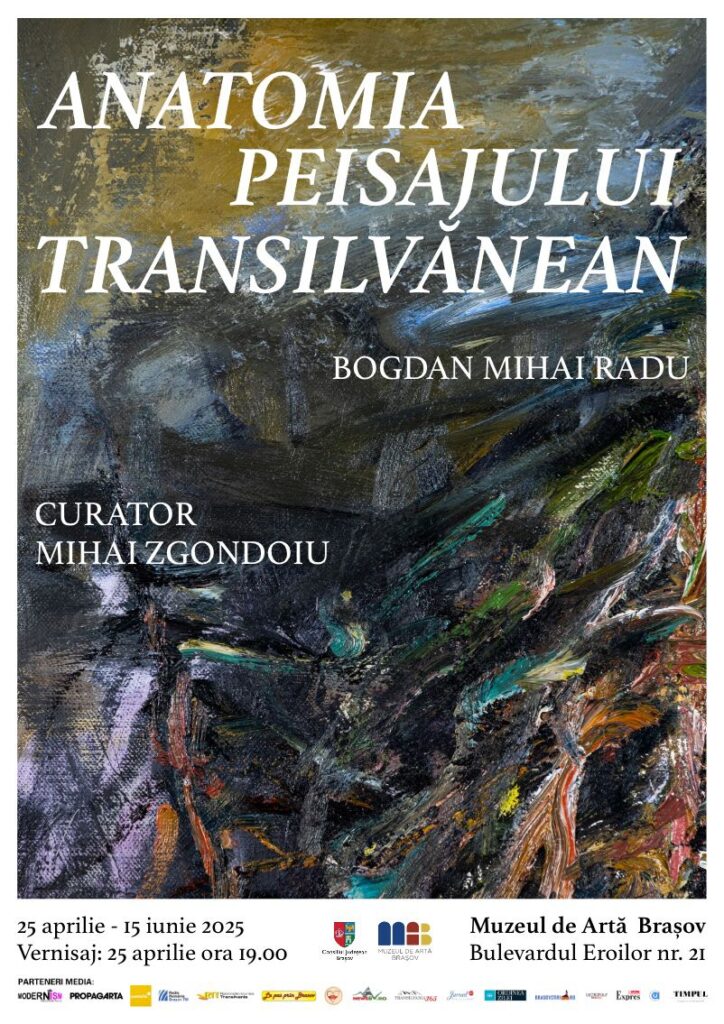
A visceral reading of nature (which sets aside the Cartesian vision of a linear and idyllic landscape) is
the new proposal of painter Bogdan Mihai Radu, in which the theme of natura naturans is revealed through bold strokes and inner turmoil. Subjected to the active process of creation. accumulating and assimilating the forces and active principles of nature, the dynamic essence of existence, the artworks created by the Iransylvanian artist raise questions or dilemmas: is the landscare a metaphorical doubling of the artist, or a necessary reflection?
His oil paintings, complemented by sketches, washes, and mixed media on paper, construct an affective and sensory cartography of the Transylvanian forests. These are not descriptive representations. but rather poetic radiographies of the landscape. The trees are transformed into characters, into contorted witnesses of time and climate, into traces of a place’s memory. The impasto texture, the gestural quality of the pictorial matter, the strained palette of earthy tones, violets, greys, and scattered patches of light, they all build an intense, almost tectonic universe in which nature seems to reveal its own body. Yet, Bogdan Mihai Radu maintains a subtle balance between chromatic lyricism and compositional drama. His artworks emanate a raw power, tinged with melancholy. They seem to capture that liminal moment between winter and spring, between decay and rebirth.
A state of waiting and tension specific to the ancient forests of Transylvania Upon a deeper inspection, echoes of artists Chaim Soutine and Anselm Kieter become apparent in BMR’s paintings. From Soutine, he seems to have borrowed the nearly visceral intensity of the brushstroke and the inclination toward the poetic distortion of form. At the same time. a subtle connection to the grave and layered universe of Anselm Kiefer can be identified, especially in the cloudy, earthy hues and, above all, in the way that painting becomes a form of introspection. Nature is not merely observed, but lived, absorbed, and transformed into texture and visual memory. Thus, Bogdan Mihai Radu does not quote, but metabolizes. He transforms these influences into a personal language, where the painterly gesture becomes an instrument of revelation.
This exhibition is an almost dreamlike journey into the deep layers of an affective geography. The Anatomy of the Transylvanian Landscape becomes an act of reconstruction, a pictorial archaeology of nature, but also an introspection into the very fiber of a place that continues to pulse in the
collective imagination.